Looking for a job can quickly become overwhelming.
There are many job boards, recruitment websites, company career pages, social media posts, and professional platforms publishing opportunities every day. For a serious job seeker, this creates a new problem: there may be many jobs available, but only a small number may truly fit your skills, experience, location preferences, salary expectations, and career direction.
That is where AI-powered job matching becomes useful.
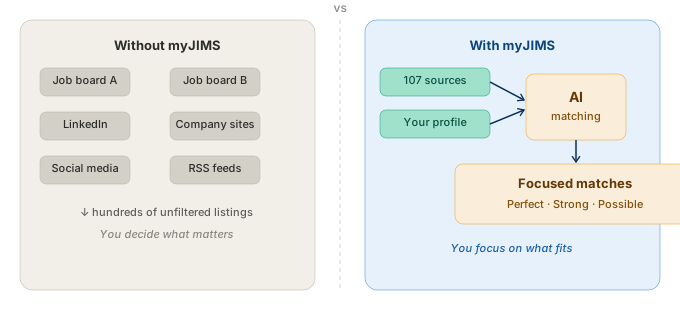
AI job matching is not about replacing your judgment. It is about helping you focus your attention where it matters most.
The problem with searching everywhere
Traditional job searching often depends on manual effort.
You visit different websites, search using different keywords, open many job posts, read descriptions, compare requirements, and decide whether to apply. This can work, but it is time-consuming and inconsistent.
Some good opportunities may be missed because they were posted on a platform you did not check. Others may be overlooked because the job title looked different from what you expected. Sometimes, you may spend time applying for roles that are not a strong fit, while better opportunities remain hidden in the noise.
The challenge is not just finding jobs. The real challenge is finding the right jobs quickly enough.
What AI matching does differently
AI matching starts by understanding your profile.
Instead of only searching by job title, a good matching system looks at a wider set of signals: your skills, experience, preferred roles, career level, industries of interest, location preferences, and the type of opportunities you are targeting.
It then compares those signals against job descriptions from multiple sources.
This helps surface roles that may be relevant even when the job title is not an exact match. For example, someone with infrastructure, cloud, systems administration, and IT operations experience may match roles under different titles such as IT Manager, Infrastructure Lead, Systems Administrator, ICT Project Manager, Cloud Engineer, or Technology Operations Manager.
That is the value of profile-based matching: it looks beyond one keyword.
Better focus, not more noise
A job seeker does not need hundreds of random job posts.
What they need is a clearer view of which roles deserve attention.
AI matching can help group opportunities into practical levels:
- Perfect Fit — roles that closely match your background and goals
- Strong Match — roles worth applying for with minor gaps
- Possible Match — roles to review carefully before deciding
- Not a Fit — roles that do not align with your profile
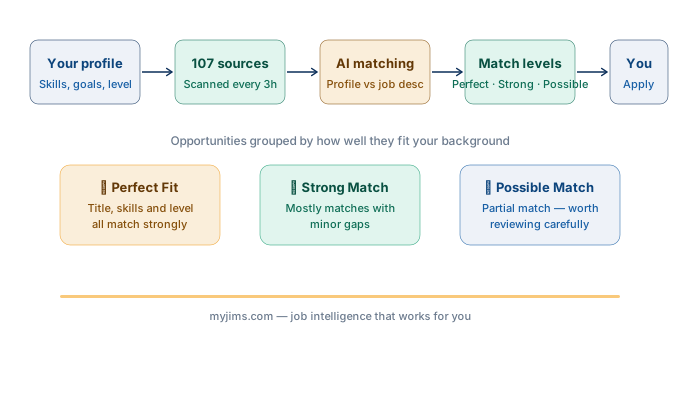
This makes the job search more manageable. Instead of treating every job post the same, users can start with the strongest matches, review possible matches later, and ignore roles that clearly do not align.
This saves time and energy.
It also helps users become more intentional. A person can ask better questions:
- Is this role aligned with my experience?
- Do I meet the key requirements?
- Is the sector relevant to my goals?
- Is this worth applying to now?
- Do I need to improve my profile for this kind of role?
That shift from browsing to decision-making is important.
Why relevance matters
Applying for many jobs is not always the same as making progress.
A focused job search is usually stronger than a scattered one. When users apply for better-fit roles, they can spend more time tailoring their CV, preparing a stronger cover letter, and understanding the employer's needs.
Relevance improves the quality of action.
It helps job seekers avoid wasting time on roles that are too far from their background, too junior, too senior, outside their preferred location, or unrelated to their career direction.
AI matching helps users see where their profile has the strongest connection to the market.
AI is a guide, not a guarantee
It is important to be clear: AI job matching does not guarantee employment.
No platform can honestly promise that. Hiring decisions depend on many factors, including the employer, competition, timing, interview performance, salary expectations, and business needs.
What AI can do is improve the discovery process.
It can help users find relevant opportunities faster, reduce manual searching, and make better-informed decisions about where to spend their application effort.
The final decision still belongs to the job seeker.
How myJIMS uses this idea
myJIMS was built around the belief that job searching should be intelligent, consistent, and focused.
The platform scans multiple job sources, compares opportunities against a user's profile, and highlights roles that are more likely to fit their background and goals. Instead of checking many platforms manually every day, users can rely on myJIMS to help surface relevant opportunities in one place.
This does not remove the work of applying.
But it helps make that work more focused.
The future of job search
The future of job search will not be about endless scrolling.
It will be about better matching, smarter alerts, stronger profile intelligence, and more informed application decisions. Job seekers will still need discipline, preparation, and persistence — but technology can help reduce noise and improve focus.
AI job matching is one step in that direction.
It helps turn a crowded job market into a clearer opportunity pipeline.
And that is the goal of myJIMS:
Job intelligence that works for you.
Ready to find better-fit opportunities?
Join myJIMS and let AI-powered matching surface the roles that truly fit your background and career direction.
Get Started — It's Free →